
slot gacor viral tiktok

The slot gacor viral tiktokarrival of American ground invasion forces in the Middle East over the weekend provides Donald Trump with the muscle for a perilous attempt to forcibly open the strait of Hormuz, Iran’s biggest pressure point in the war.
Iran’s chokehold on the strait, through which a fifth of the world’s oil trade normally passes, gives Tehran leverage that Trump understands, sending oil prices rocketing to more than $100 a barrel. The American president says he’s prepared to give diplomacy a chance, though bombing of Iran continues.
But even for talks, the dealmaker will seek a better hand. Trump said on Sunday that he wants to “take the oil in Iran”.
Trump has two military options to open the strait: seizing territory, or deploying a massive naval presence in the waterway. Even the limited ground incursion being considered risks the kind of body count that could sink a presidency, experts say. For Iran, boots on the ground would be a red line.
Emma Salisbury, a senior fellow in the national security programme at the Foreign Policy Research Institute, said Trump would not be able to resist escalating the conflict, by capturing one of the Iranian islands in the Gulf. He could use that to bargain.

“At every point so far he’s gone for it, and I can’t see this being any different. He will use the soldiers if they’re available,” she said. “I think that will go horribly wrong and there will be a lot of casualties.”
Iran has sent a threat, according to mediators: it will carpet bomb its own territory to kill any American soldiers on its soil. Tehran warned that it is prepared to blow up its own infrastructure to hit the invading forces, according to diplomats involved.
The speaker of Iran’s parliament, Mohammad Bagher Ghalibaf, on Sunday accused the US of publicly seeking talks while planning a ground assault. “Our men are waiting for the arrival of the American soldiers on the ground to set them on fire and punish their regional allies once and for all,” said Ghalibaf, who is regarded as a likely Iranian representative if peace talks take place.
Half of a contingent of 5,000 marines, specialised in amphibious landings, arrived in the Middle East on Saturday. About 2,000 paratroopers are also due to arrive.
Kharg Island, a tiny Iranian outpost used as the country’s main oil export terminal, is the most obvious target. Seizing one or more small islands would be the easier part, though a force of this size would be spread thin, experts say. Once there, the danger really begins. Iran would rain down rocket, missile and drone attacks.
The numbers are far short of requirements for a significant land operation – about 150,000 troops were deployed in the 2003 US invasion of Iraq, and Iran’s territory is more than three times the size. US media reports said a third aircraft carrier was heading to the Middle East and that the administration was considering dispatching another 10,000 soldiers.
Trump is also weighing an ever riskier and more complex mission: swooping into the Iranian mainland to seize the country’s stockpile of highly enriched uranium, thought to be buried at one or more sites that were bombed last year. That would require special operations forces.
“Maybe we take Kharg Island, maybe we don’t. We have a lot of options,” Trump told the Financial Times. “It would also mean we had to be there [in Kharg Island] for a while.”
Kharg is deep inside the Gulf, well past the strait of Hormuz, adding logistical difficulty and vulnerability for US soldiers.

Sitting in the strait itself are a series of Iranian islands that command the waterway, the largest of which is Qeshm. Three of the smaller islands, Abu Musa, Greater Tunb and Lesser Tunb, claimed by the United Arab Emirates, provide the backbone of Iran’s hold over the channel.
Ruben Stewart, a senior fellow for land warfare at the International Institute for Strategic Studies, said the deployment may just be a show of force to strengthen the American negotiating position, as it would be tough to hold any island for more than a few days.
“It is feasible that they could land on some of those locations,” he said. “It seems extremely unlikely that could achieve anything in a military sense.”
Ground operations may not end the Iranian threat anyway. To open the strait for navigation, while attacks on ships continue, would require naval escorts for commercial vessels along with mine sweeping and air support.
That mission would need so many warships that the US would have to lean on allies such as the UK and European nations. The US is short of mine sweepers in particular. So far, its military says it does not have the resources to guard commercial ships.
The challenge could be about to multiply. Iran-allied Houthi forces in Yemen entered the conflict on Saturday, firing missiles at Israel. They could begin attacks on vessels passing the narrow strait at the southern end of the Red Sea, another crucial shipping route in the Middle East, leaving the US with two waterways to secure.
- US-Israel war on Iran
- Strait of Hormuz
- US military
- US foreign policy
- Iran
- Middle East and north Africa
- features
Live Middle East crisis live: Trump says he wants to ‘take the oil’ in Iran and could seize Kharg Island ‘easily’
Iran accuses US of plotting ground assault while publicly seeking talks
Funeral held for three journalists killed by Israeli strike in Lebanon
US has destroyed only a third of Iran’s missiles, intelligence suggests
Houthi forces enter Iran conflict with missile attacks on Israeli military sites
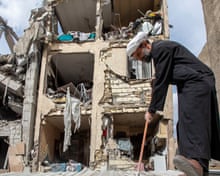
Yemen’s Houthis launch first attack on Israel since outbreak of conflict, as Rubio says war to end in ‘weeks’
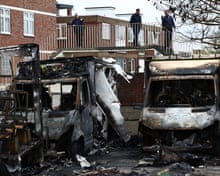
Biker gangs and hired hands: how Iran is increasingly outsourcing its terrorism campaigns
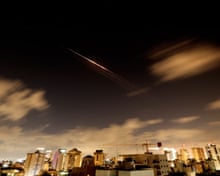
European intelligence agencies believe Russia is supplying drones to Iran, says official
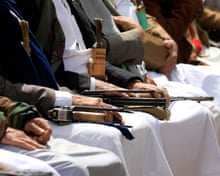
Gulf countries warn of rising threat from Iran-backed militias and proxies
A war of regression: how Trump bombed the US into a worse position with Iran


Most viewed
Most viewed
- World
- US politics
- UK
- Climate crisis
- Middle East
- Ukraine
- Environment
- Science
- Global development
- Football
- Tech
- Business
- Obituaries




Comments